By Ibanga Isine
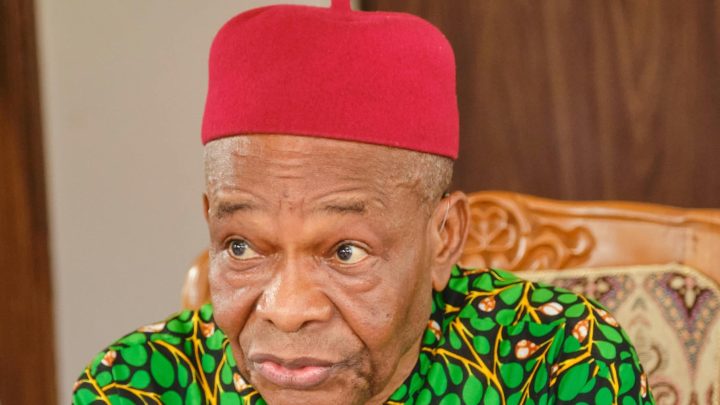
Chief Nduese Essien, former Minister of Lands, Housing and Urban Development and one-time leader of the South-South Parliamentary Caucus of the National Assembly (1999–2007), turns 82 today. In a political environment like ours, often defined by convenience, silence and conformity, Chief Essien comes as a rare politician: fearless, detribalised, vocal, and deeply rooted in his people.
An unapologetic Ibibio son, he has contributed immensely to the political and socio-economic development of Akwa Ibom State and Nigeria. Despite serving in some of the highest offices in the land, he chose to live among his kin in his village, Ntisip and maintain a strong organic connection with the grassroots. At 82, he remains mentally sharp, physically strong, and intellectually engaged.
It is, therefore, not surprising that he has recently been drafted, alongside other eminent Niger Delta leaders, to help resolve the lingering political crisis between the Minister of the Federal Capital Territory, Nyesom Wike, and his estranged godson and Governor of Rivers State, Siminalayi Fubara. He has served on many high-level committees charged with resolving the county’s problems, including the Niger Delta Technical Committee and the National Constitutional Conference of 2014. He is a consummate politician and businessman who knows when to fight and when to retreat.
Long before I met Chief Essien personally, I had benefited from his quiet interventions. As a student at the University of Uyo, I frequently patronised the Students’ Care Bookshop near the library at what is now the Town Campus. His books were affordable, and sometimes I would read and take some notes because I could not afford to buy them. It was only much later that I realised the hand behind that lifeline for struggling students.
You can also read – Ex-Minister Essien Blames Tinubu Government as Nigeria’s Security Crisis Spirals
I met him formally in 2004 while working as a National Assembly correspondent for The Punch in Abuja. At the time, I was posted to the House of Representatives alongside Chiawo Nwankwo, a journalist of uncommon daring and resourcefulness. Chief Essien was every reporter’s delight. He spoke when others chose silence. He granted interviews on issues many of his colleagues would not touch. During the intense struggle over resource control and the onshore–offshore oil dichotomy, he became the unmistakable face and voice of the advocacy within and outside the National Assembly.
His leadership of the South-South Caucus and his robust engagement with federal lawmakers earned him widespread respect, including from his colleagues and among journalists covering the legislature. He was also instrumental in the passage of the NDDC Establishment Act and the laws that created the EFCC and the ICPC. Little wonder he was appointed Chairman of the House Committee on Anti-Corruption, National Ethics and Values.
Long before I met Chief Essien personally, I had benefited from his quiet interventions. As a student at the University of Uyo, I frequently patronised the Students’ Care Bookshop near the library at what is now the Town Campus. His books were affordable, and sometimes I would read and take some notes because I could not afford to buy them. It was only much later that I realised the hand behind that lifeline for struggling students.
Coming from Akwa Ibom and having been transferred to Abuja after being practically chased out of Rivers State, I naturally gravitated towards him. I believed deeply in the resource control struggle and the call for true federalism. Before long, I became his closest journalist and began coordinating his media engagements—without pay.
Our relationship, however, was not without its defining test.
During the heated debates over President Olusegun Obasanjo’s third-term bid, Chief Essien was one of the most vocal opponents. So, when he returned from Akwa Ibom after consulting his constituents and took the floor of the House to speak in favour of tenure elongation, I was shocked and devastated. Worse still, my colleagues mocked me openly. When the bid was eventually defeated by an overwhelming “No,” I confronted him angrily, alongside other journalists. We heckled him. I stopped taking his calls.
Then came the moment that changed everything.
One day, he cornered me in the lobby and asked, half-jokingly, “Ibanga, are you ready to kill me for supporting a third term?” Before I could respond, he added, “I could be your father. If your father made a mistake and apologised, would you listen to him?” He explained calmly that he spoke based on the advice of his constituents, even though he personally opposed the bid. “Now that third term is over,” he said, “why are you still behaving like I killed someone?”
That evening, I called to apologise. He apologised too. And we moved on.
When President Goodluck Jonathan appointed him minister—following his nomination by then Governor Godswill Akpabio—Chief Essien insisted that I work with him as his Special Assistant on Media and Administration, despite pressure from powerful interests to choose otherwise. I served as the engine room of his office and, unsurprisingly, ran into trouble repeatedly for insisting that things be done right.
You can also read – I Have Not Joined APC: Ex-Minister Essien
In my very first week, I clashed with the Permanent Secretary over the arbitrary eviction of a senior officer. I intervened to prevent a crisis. Though the action was reversed, the PS demanded my removal. Chief Essien refused. Instead, he asked that I be queried. My written response, backed by civil service rules, was upheld. The matter ended there.
The real test came later, when I advised him not to approve a sensitive file that top officials had cleared. I insisted he take it home and study it. He was furious. I walked out, drafted my resignation, and prepared to leave. That night, he went home, reviewed the file, and discovered I was right. He called me back, apologised, and thanked me for protecting his integrity.
We worked together until the end of his tenure.
Today, years after he left office, I remain the only member of his ministerial team who is still a close confidant and family friend. We still disagree. We still argue. But we listen to each other.
Chief Nduese Essien is not a fan of praise-singing. He is blunt, humorous, and sharply witty. But at 82, his life has offered me and a lot of others a rare lesson in courage, conviction, humility, and the grace to admit error.
Working with him over the years, I have discovered that Chief Essien does not take prisoners. He tells you precisely what he thinks, directly, bluntly, and without regard for closeness or comfort. It is a quality that most of his contemporaries abandoned long ago for survival, and I believe they envy him. He does not go where he is not invited, and even when they do, he avoids making courtesy appearances. If the event lacks substance or the invitation smells of vanity, he keeps away.
On this historic milestone, I wish him good health, a sound mind, and a peace that is both regenerative and surreal. Happy 82nd birthday, Chief.