By Ibanga Isine
Leaders succeed or fail largely based on the quality of counsel they receive and the kind of feedback that comes from constructive followership.
The Best, the Bad and the Ugly
Over the past one year, I have seen a lot about Akwa Ibom State on social media. I have also visited the state, spoken with people, driven through communities, and seen things firsthand. What is happening is a typical Nigerian cocktail of the good, bad, and ugly.
Before anyone accuses me of attacking the government, let me explain my position clearly. I am not here to flatter anyone. I do not belong to a praise choir. If you make a living praising a leader, this intervention is not for you. This is about looking the Akwa Ibom State government in the eye and telling it the truth, frankly and unequivocally. You are, therefore, free to attack me if that will help you pay your bills.
I believe leaders succeed or fail largely based on the quality of counsel they receive and the kind of feedback that comes from constructive followership. While the Constitution empowers citizens to question those in authority, that responsibility must be exercised with fairness and honesty. It calls for appreciation where it is deserved and criticism where it is necessary. That is why this intervention is intentionally a mixed bag—offering both commendation and caution in the interest of progress.
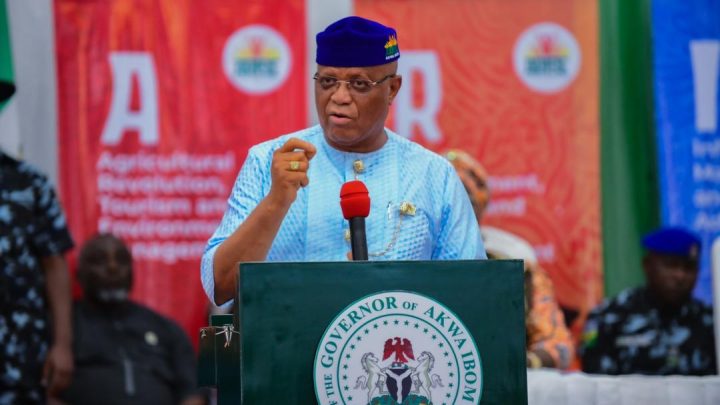
Governor Umo Eno has been in office for two years, seven months, and some days. During this time, he has launched many programmes and projects that have had a direct impact on the lives of our people. Let us look at the pensions and gratuities owed to our senior citizens. It is impossible not to commend the governor for resolving a worrisome backlog of pensions and gratuities owed to senior citizens, some dating back 14 years before he took office. He made a solemn promise during his campaign and has carried it out honourably. This matters in a country where promises are frequently made and broken.
At the grassroots level, the one-project-per-local-government strategy has produced tangible results. Model primary healthcare centres, schools, and hospitals are popping up in previously underserved areas. For the first time in a long while, local governments have gotten significant funding, and chairpersons in some places have made noticeable investments in development. In certain local governments, governance is worse than child’s play. This is an area that requires a more rigorous oversight and less tolerance for mediocrity.
Governor Eno has created many emotionally moving moments that were so genuine and in real time. Through Ibom-LED, the government has helped small and medium-scale businesses throughout the state. I recall the story of Mr Jones Akpan, a physically challenged shoemaker who benefited from the Ibom-LED scheme. At the passing-out ceremony of one of the cohorts, the governor did something simple yet profound. He went down on his knees to make eye contact, shook the man’s hand warmly, doubled his grant, and directed that a workshop and showroom be built for him. That single encounter transformed the man’s life and also showed that power, when used with love, can restore hope and enrich life.
You can also read – Why Fixing Potholes Won’t Eliminate Bad Roads in Uyo
More recently, there was Chris Vic, a visually-impaired young man with a beautiful voice. It was very touching to watch the governor approach him on the podium at the Christmas Village, embrace him, and announce the gift of a three-bedroom house complete with a standard studio, as well as a monthly N1 million stipend for the duration of his administration. That was not purely charitable. It was an urbane, confident, and compassionate display of leadership. I watched the show on social media, and my eyes were drenched with tears of joy and appreciation. Thank you, Sir, but please do not forget his manager, who paused his life to help Chris develop the wings to fly.
Governor Eno has refused to take on unnecessary loans since his inauguration. Instead, he has focused on repaying inherited debts accumulated during previous resource booms. By June, Akwa Ibom owed $40.3 million in multilateral debt and ₦105.8 billion in domestic debt according to the Debt Management Office (DMO). By November, the state cleared all outstanding commercial bank loans inherited from the previous administration, totalling ₦39.831 billion, including interest and penalties. The governor inherited over N210 billion in debt when he came into office. This is a commendable move in a nation where borrowing has become the norm.
Again, through reforms like AKWAGIS for land administration, AKWAREMIT to tighten financial leakages, and strategic measures to widen the tax net, including tapping into the maritime sector, the administration has been focusing on improving internally generated revenue.
The governor should be commended for his work in the health sector, which is currently one of the best in the country. Every senatorial district now has an oxygen plant. Ambulance and emergency services now operate round the clock, and workers now have access to health insurance. While many primary health centres are being constructed or remodelled, a new general hospital has been built and inaugurated in Ukanafun.
While doing all that, the governor declared a state of emergency in the health sector, approved the hiring of 2,000 health workers, resumed the payment of rural posting allowances, and gave the nod for improved entry points not only for medical doctors, but also for other healthcare professionals in a purpose-driven system-wide reform. He has sustained the tempo of environmental cleanliness that has made the state lead others in the federation.
Agriculture, too, has received structured interventions. From the ongoing Ibom Model Farm to the delivery of agro-inputs to public schools, large-scale farmers, rice farmers, cooperatives, and fishing communities, the intention is clear. The distribution of cocoa and oil palm seedlings, integrated farming training for young people, establishment of wet markets in local governments, and the AK-CARES initiative all form part of the effort to restore dignity to farming and improve rural livelihoods.
For some time now, the street fights among secondary schools in Uyo city have abated, and the government is making moves to hire more teachers at the basic education level. However, the payment of promotion allowances to primary and secondary school teachers is still a problem.
So why should Governor Umo Eno not falter?
Because the early signals show Mr Eno as a leader attempting imperfectly, but sincerely, to govern with empathy, prudence, and restraint. Because Akwa Ibom has seen enough seasons of squandered goodwill. Because consistency, not complacency, is now crucial. And, because the gap between promise and performance is where public trust grows or dies, we must help the governor succeed by not ignoring what he appears to do poorly.
I had previously discussed how the governor empowered Mr Akpan, a physically challenged bespoke shoemaker, by ordering that a proper workshop and showroom be set up for him. When I visited Uyo sometime last year, I decided to stop by and see how Mr Akpan was doing and how far the governor’s instruction had been carried out. What I saw was heartbreaking.
Several months after the promise was made, some walls of the old lockup shop that Mr Akpan used as a workshop were knocked down, and the rusted roofing sheets were removed in a shoddy attempt at renovation. In the process, Mr Akpan’s life, family and business were halted. The slow and poorly executed renovation affected the living area within the shop, causing the man, his wife and children to sleep outside for months.
Shocked at what I saw, I immediately reached out to those handling the job to know if they were actually carrying out the governor’s mandate or something else. More troubling was that they used asbestos on the ceiling. It took strong pushback from me before it was replaced with a safer PVC ceiling. At the end of the exercise, Mr Akpan had a low-budget lockup shop from the contractor and high-quality equipment installed by Ibom-LED. Although I cannot say how much was provided for the job, I know that Governor Eno would not have been proud to cut the tape and hand over that project.
You can also read – An Open Letter to Governor Umo Eno – Part I
I bring this up because it underscores a recurring issue where some persons tasked with implementing the governor’s policies end up shortchanging the citizens whom such programmes were meant to benefit. That is why it is necessary to exercise caution when selecting and supervising those tasked with carrying out promises made to vulnerable citizens, such as Chris Vic. Able-bodied people who are employed and enjoying salaries, perks, and goodwill should not be allowed to alter, dilute, or corner what is intended for those in need. This is also why the delivery of Chris Vic’s home and studio requires special attention.
Looking at infrastructure development over the past year, there have been activities, but little progress. The situation is basically the same, from the Judiciary Village to the Aviation Village, the Medical Village, Youth Friendly Centres, Local Government Chairmen’s mansions, and even newly constructed hospitality centres in Lagos and Abuja. Work has come to a standstill.
The contractors had rushed to the site on the assurances that mobilisation would be paid within weeks, and some took high-interest loans to start work. Days moved into weeks, weeks into months, and now over seven months have passed without payment. Some of these projects, I understand, were meant as empowerment initiatives to young people and political stakeholders.
What was conceived as empowerment has now become a source of avoidable pain, hardship, and losses to people. The governor, who is a businessman, knows that leaving contractors stranded after they have committed resources does not strengthen livelihoods; it weakens and destroys them.
I am pleading for them because of the underlying issue of groupthink and fear culture in the power equation. When dealing with power, people often choose silence over truth and peace over honesty, even when silence is harmful. Contractors, instead of openly airing their concerns, whisper among themselves and wait for someone else to speak first. I am told this fear affects even the biggest players in the construction sector, many of whom are now struggling with lenders over overdue repayments. Some contractors have fled their homes after creditors unleashed security agents on them.
There is also the question of how bills of quantities are validated. The governor’s strategy was clearly designed to limit abuses and protect public funds, and that intention is laudable. However, in reality, the procedure has created a significant bottleneck in the procurement process.
Instead of streamlining project delivery, it has significantly slowed operations. Delays are unavoidable when a single individual is responsible for confirming bills across multiple project sectors. Aside from delays and lack of expertise across project fields, this concentration of authority, no matter how well-intentioned, might unintentionally create pressure points within the system.
You can also read – An Open Letter to Governor Umo Eno – Part II
A more effective strategy could be to appoint a small team of professionals with demonstrated integrity, experience, and exposure to handle the scrutiny of bills of quantities. Such a team may analyse submissions, benchmark costs, and offer a fair and reasonable project price. This promotes accountability, increases transparency, and accelerates decision-making. Experience has shown that establishing distinct power blocs inside the procurement and project management chain exposes the system to exploitation and unnecessary conflict. Such an outcome would clearly undermine the governor’s objectives of fiscal responsibility, accountability, and value for money.
I am also aware of how some of these projects were structured financially. In many cases, I learned that contracts are awarded with low profit margins where contractors go home with little or nothing after withholding tax and VAT are deducted. Such arrangements are counterproductive, especially when project funding is delayed for more than seven months with no clear provision for cost adjustment to reflect inflation and market realities. Rising material costs, interest on borrowed funds, and prolonged idle time at the site gradually erode the narrow profit margin.
If nothing changes, many contractors may end up completing, or attempting to complete, projects at a loss, or simply walk away with nothing after months of commitment. Alternatively, they may resort to cutting corners and delivering substandard projects, contrary to the government’s intention.
This intervention comes from the place of support rather than criticism. The governor’s ARISE Agenda is clear, well-intentioned, and people-centred. The difficulty has never been in policy conception, but in implementation. When good ideas are badly executed, the promise behind them is undermined, service delivery is weakened and public confidence drops. Paying more attention to execution, oversight, and feedback will not only protect the governor’s legacy but will also ensure that empowerment genuinely empowers, infrastructure truly serves the people, and governance provides a measurable impact rather than motion without movement. Honest reflection, prompt correction, and openness to constructive criticism are often the most powerful weapons of good leadership.
As the year draws to a close, we wish the government and the people of Akwa Ibom State a joyous and peaceful Christmas. May the new year bring renewed strength, clarity of purpose, and a shared resolve to do things right. Have a merry Christmas and a beautiful new year ahead.