By Ibanga Isine
A lot has happened in Akwa Ibom before and after June 18, when the very Honourable Magistrate Godwin Edemekong of Magistrate Court 7, Uyo Magisterial District, ordered me to leave his courtroom. It was a deeply humiliating experience for me, and I have continued to struggle with what I consider to be a gross violation of my right to dignity and a fair hearing. However, even as I deal with that troubling encounter and the growing menace of herders keeping cattle for our politicians and top military brass, Akwa Ibom has continued to give me reasons to be proud.
The official opening of the international wing at Victor Attah International Airport was a watershed moment. The launch of the Medical City Project will transform healthcare delivery, while the arrival of a fleet of elegant CNG buses shows a commitment towards modern public transportation. These are concrete accomplishments that deserve recognition by people of goodwill.
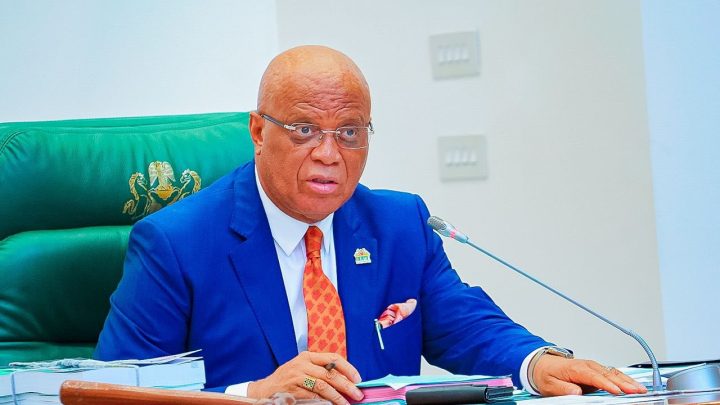
Governor Umo Eno deserves the spotlight for these achievements. They show a genuine commitment to bringing sustainable development to the state, and I have always believed that good work should be appreciated, regardless of political views or personal experiences.
My only reservation is the government’s response to criticism. Development is measured not just by the projects commissioned, but also by a leader’s willingness to listen when citizens identify areas that need urgent attention. Constructive criticism is not an attack on government; rather, it often serves as an encouragement to make good governance even better.
That is what this is all about, and that is why I could not ignore the message I got in my inbox some time ago. A former Akwa Ibom State College of Science and Technology student contacted me via social media, complaining about the institution’s poor state and the uncertain futures of many of its graduates.
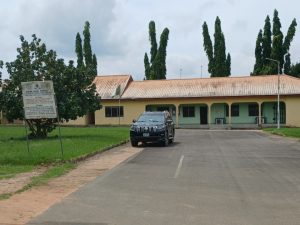
Akwa Ibom State College of Science and Technology, Nung Ukim, Ikono
According to that former student (name withheld), many students who graduated from the college have struggled to find work or seek new opportunities due to the lingering issues about the institution’s status, accreditation, and credibility.
It was former Governor Udom Emmanuel who signed the bill changing the Akwa Ibom State College of Arts and Science to the Akwa Ibom State College of Science and Technology in 2023. The transformation was designed to reposition the institution as a hub for technical education and innovation. Instead, it seems to have created more questions than answers.
On May 5, 2026, I visited the institution out of curiosity and concern. When I arrived at 9:25 a.m., I was met with the ghost of what should have been a bustling institution of higher learning.
The administrative block, which should have projected the impression of a contemporary higher institution, looked like the headmaster’s office in a glorious primary school. The campus was unusually quiet. There was no sign of academic activity, student participation, or the intellectual energy that one would expect from a functional institution.
You can also read – Hospital Siege: How EFCC Operation Caused Deaths, Missing Patients at UUTH – Part I
Several staff members were seated in their offices in the administrative block. Some seemed idle, while others were treating files. The contrast between the presence of staff and the absence of students raised my concern about the institution’s actual state.
As I walked around the campus, signs of deterioration were becoming more apparent. The buildings had deteriorated. Facilities appeared abandoned. Several structures showed clear signs of deterioration. Before me was a school intended to prepare young people for science, technology, and innovation, but it had been trapped in stagnation.
Truth be told, not everything on the campus was neglected. I also came across a few buildings that seemed relatively new, well-built, and well-maintained. I peeped into what looked like laboratories and found modest but functional furniture and equipment, suggesting some level of investment. Unfortunately, no one was prepared to discuss when the facilities were built, whether they were fully equipped, or their role in academic activities. The silence made it difficult to determine if these structures were the beginning of a genuine rehabilitation or isolated pockets of progress in an institution that is still trying to find its feet.
As I approached what turned out to be the Council Chamber, I heard loud prayers and heavy thuds echoing throughout the building. For a moment, I thought whether the space had been rented to a church for a deliverance service. But as I got closer, I realised it wasn’t a church gathering. Some staff members were desperately praying to God to send help to their institution.
On that Monday morning, senior staff members had gathered unusually early. From what I saw, the prayer meeting seemed to have been the last resort for people who thought they had exhausted all administrative and formal channels available to them.
The scene instantly transported me to my childhood in Nung Ukana, Ibesikpo. A new church had opened in the village, and its members prayed so hard and wept so profusely that the villagers nicknamed them “Obongtua,” those who prayed and cried.
That’s exactly what I saw inside the Council Chamber. I heard voices trembling with emotion. I heard groans of misery. I heard passionate declarations from men and women overwhelmed by frustration, uncertainty, and helplessness. It became impossible not to conclude that they had exhausted human effort and decided to hand over the institution to God.
Of course, my presence did not go unnoticed. Some staff from the Registrar’s office approached me, asking who I was and why I was there. I identified myself as a journalist and community advocate. They were polite yet obviously uncomfortable. None agreed to talk to me, probably for fear of being sanctioned under a policy that discourages institutional heads from allowing journalists access to record the decay afflicting public schools.
In an institution straddling four Nung Ukim villages and extending to the Anakua River, with over 90 academic personnel and roughly 130 non-academic staff members, I discovered just three students and a lone woman selling snacks.
You can also read – Holy Week Thoughts for Governor Umo Eno
That picture has been with me ever since. Beyond the physical degradation, there is a far deeper tragedy: the uncertainty that young people face since their dreams are tied to the institution. Education is more than just changing a name through legislation or installing beautiful signage. It is about establishing an environment in which learning thrives, skills are developed, and certificates obtained become passports to opportunity rather than sources of fear.
If the conversion to a College of Science and Technology was genuinely meant to provide opportunities for young people, the Akwa Ibom State Government must provide the public with clear answers. What is the accreditation status of the college? What are the plans for infrastructure rehabilitation? Is the curriculum in line with contemporary industry needs? What guarantees can be offered to students and graduates whose futures depend on the institution’s functionality and credibility?
Parents who invest in their children’s education deserve assurance. Students have a right to be certain that their years of education will result in opportunity rather than disappointment. Akwa Ibom has earned a reputation as a state that prioritises education and human capital development. That reputation should not be tarnished because one public institution has fallen into decay.
I deliberately began my piece by commending Governor Umo Eno’s good performance in infrastructure and public service delivery because fairness compels us to recognise and appreciate what is done right. However, fairness also requires us to be honest about what is working and what is not.
Governments earn enduring respect not by resisting criticism, but by being willing to confront uncomfortable truths and act on them. One of such uncomfortable realities is the story of Akwa Ibom State College of Science and Technology. This is not cyber- stalking or bullying. It is about the future of our young people, and it deserves deliberate action rather than a defensive response. It demands transparency, adequate funding, academic reform, and leadership driven by a genuine desire to educate our people.
Development is complete when governments celebrate airports, hospitals, and transportation networks while simultaneously rescuing failing educational institutions. That is the dream many of us have for Akwa Ibom. And it’s the Akwa Ibom worth believing in.
Thank you, Governor Umo Eno.