
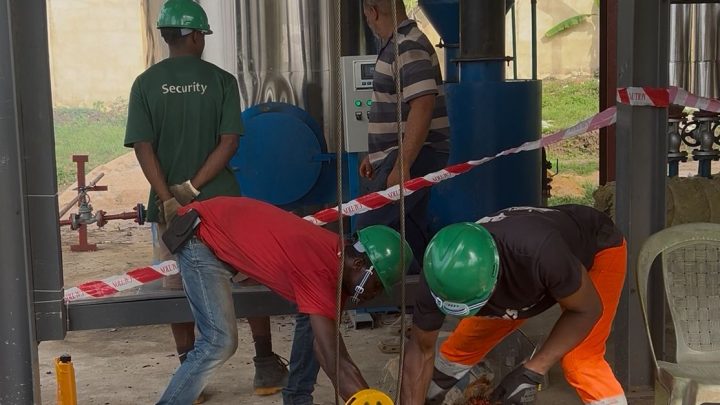
By Ibanga Isine
A major industry is springing up inside an old family compound in Ikot Akpafuk, Ndiya, a quiet community in Nsit Ubium Local Government Area of Akwa Ibom State. For many indigenes of the community, the compound is not new. It has always been a part of their shared history. It is the birthplace of the late Chief Aniema Obot Ubom, the father of Ifiok Ubom and many siblings.
Although Ifiok Ubom was born in Enugu and raised in Calabar with his siblings, it was a family tradition to visit Ikot Akpafuk regularly during holidays from school and most particularly, the Christmas season was always spent in the village.
As far back as the early ‘70s, this family compound hosted ATC FARMS, a multi-agricultural business with a palm mill, poultry, pineapple orchard, etc. It is where Ifiok and his siblings first saw how oil palm could shape the destiny of a people.
Oil palm was not just a crop; it was the backbone of the family’s progress. Today, that same 1.5-hectare family compound tells a new story. Where a simple mill once stood, modern processing plants and heavy equipment now operate.
The patriarch, Chief Ubom, planted the seeds that have now grown into what is known today as Ubom Dynasty Farms (UD Farms), “right here in this family compound,” Ifiok, the CEO of the company, says, pointing to the very place where the vision first began.
“My father went to school in the 50s at Fourah Bay College (FBC) in Sierra Leone, sponsored by the community through funding from oil palm. He came back and established the first oil palm mill here. Two years ago, I decided as the eldest male member of the family, to keep the legacy alive.”
For a family that loved agriculture and value-addition, the project is more than business. It is about preserving the memory of a proud family and community. It is gratitude. It is a responsibility. After spending 23 years working in the oil and gas sector abroad, he returned home with a simple idea: rebuild something meaningful. At first, he said he thought of installing a modest mill, just to keep the family connection to oil palm intact. But the idea refused to stay small.
You can also read: Why Akwa Ibom Must Not Host Prophet David Owuor
Ubom chose to go big, quoting Donald Trump’s famous phrase, “either go big or go home.” What currently stands in Ndiya is not the mill that the locals are used to seeing. UD Farms is modern, well-organised and efficient. The technology is clean and new. The process is controlled. The output is steady.
Every hour, the mill can process one ton of fresh fruit bunches, or around 70 bunches. It produces at least 2,000 litres of finished palm oil each 10-hour shift. When it operates in two shifts per day, it aims to produce 20 tons of fruit and around 5,000 litres of oil. Ubom shakes his head when he compares this technology to traditional mills.
“A typical mill here would not be able to handle up to half a ton in seven days,” he says. “That’s equivalent to what we can do in 30 minutes.”
In many rural communities, palm fruits are left for several days before processing, thereby reducing quality. The work is manual and slow. At Ubom Dynasty Farms, it is different. Harvested fruits are immediately sterilised, threshed, pressed, distilled, and dried. The oil that comes out is clean, consistent, and suitable for both domestic and export markets. Even the waste is reused. The remaining bunches are burned and fed back into the system for fuel, and the ashes can be used to extract ‘otong, ‘ a major delicacy in the state.
However, doing business in a rural setting is not without obstacles. Power supply remains a major challenge. “We all know the downside with power being expensive or not available,” Ubom says.
To address this, the facility is installing a dedicated 300-kVA, 33-kV transformer and adopting a prepaid industrial line arrangement with the Port Harcourt Electricity Distribution Company. Ubom is also considering gas and solar as backup solutions, preferring cleaner alternatives to diesel.
You can also read: Victor Antai: Nigerian Politician Who Places Conscience Above Loyalty
Beyond equipment and electricity, his main interest is in people. Akwa Ibom was once famous for producing palm oil. The trees are still standing. In many communities, families have few oil palm stands on land that they inherited.
“Every family has a few stands,” Ifiok explains. “The problem is not the absence of palm trees. It is low yield and scattered production. Compared to countries like Malaysia, yields here are still modest. No massive estates are feeding large factories.”
UD Farms works with smallholder farmers across different local government areas, grouping them into clusters and buying directly from them to ensure a steady supply. “There’s more than enough in Akwa Ibom State,” Ubom insists. “It’s just not in big estates.”
To strengthen the raw materials network, he helped form the Ibom Oil Palm Export Cooperative last year. The cooperative brings together farmers, processors, merchants, and government stakeholders. The focus is practical: training farmers, supplying quality seedlings, improving maintenance, and raising yields.
He believes that as yields improve, supply becomes stable. As supply stabilises, processing increases. As processing improves, export potential grows, and everyone benefits.
The state government has taken notice of what is happening in Ndiya. Commissioner for Agriculture, Dr. Offiong Offor visited the facility and described it as “state of the art” and an “ARISE Ambassador.”
“Once you develop agriculture, you are indirectly developing the rural areas,” she says. “We’ll see what partnerships and support we can give to ensure that he has enough raw materials… to support Governor Eno’s dream in agricultural revolution and rural development.” Her position is clear: strengthening agriculture strengthens communities.
It was not only Offor who visited the plant. The Commissioner for Trade and Investment, Captain Iniobong Ekong (Rtd.), was also there and was very impressed. “I’ve never seen anything like this project,” he says.
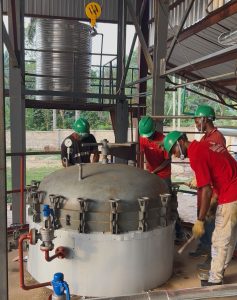
Some of the machines at UD Farms in Ndiya, Akwa Ibom State
For him, the project is more than a processing plant. It represents investment confidence. He vowed to mobilise the right networks, encourage partnerships, facilitate long-term land leases for plantations and explore export-processing opportunities to help the facility scale.
Together, the commissioners see UD Farms as a practical expression of the state’s broader agricultural drive. But for Ubom, the core vision remains simple.
“The vision here is to support food growth and strengthen the economy of the state,” he says. He talks about reinvesting profits into expansion. He talks about empowering small farmers. He talks about creating jobs in rural communities where opportunities are often limited.
In Ndiya, the purr of machines now mixes with the sounds of daily village life. Trucks come in with fresh fruit. Workers move confidently around the facility. Farmers see a reliable buyer for their harvest. The family compound that once housed a small mill has become the foundation for something bigger.
Yes, UD Farms processes palm fruits. But it does much more than that. It is rebuilding trust in agriculture. It proves that modern industry does not have to flourish only in big cities; it can thrive in the village. Beyond that, UD Farms connects the past and the future.
In the peaceful community of Ndiya, a legacy that began with oil palm decades ago is being revived. This time, it carries a fresh purpose, a clearer vision, and a greater hope for the future.
Visit Ndiya and see what is happening for yourself. See how palm fruits are processed, jobs are created, and a once-quiet neighbourhood is gradually coming back to life. UD Farms is more than simply a story to tell; it is a story that can be experienced.